News analysis ·
BILL's AI payment checks: who carries a vendor error
BILL now holds unusual vendor payments for review before money leaves. We explain how a business payment moves and who bears the loss when it goes wrong.
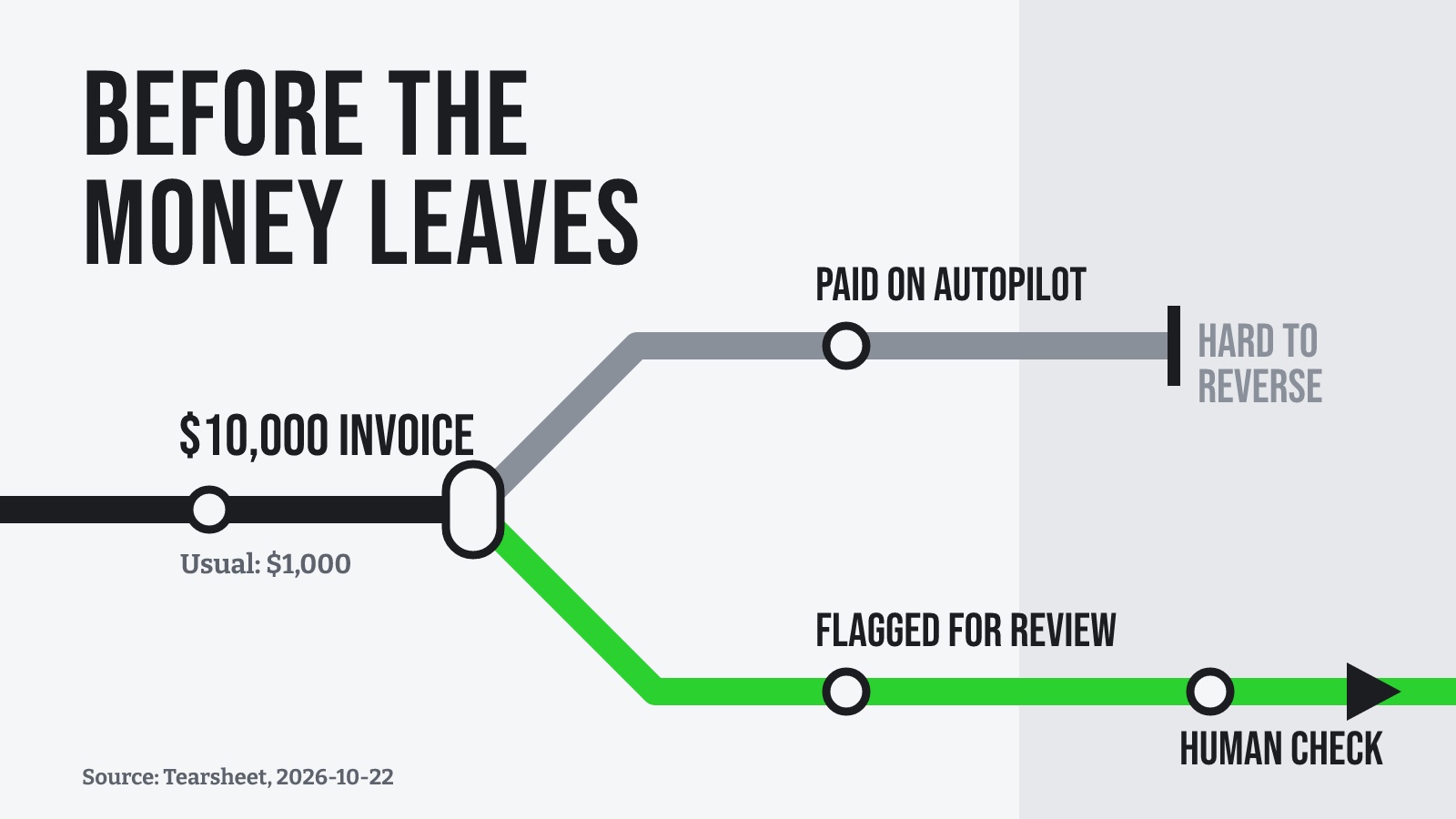
BILL, the payments platform used by many small businesses to pay their suppliers, has added AI tools that stop unusual vendor payments for a human check before the money is sent, Tearsheet reported. The company also said it has passed $2 trillion in cumulative payment volume. This article looks at where in the payment chain the check sits, and why that position matters for who ends up holding a loss.
What BILL announced
At the Money 2020 event, BILL unveiled a suite of AI tools for business finance teams, according to Tearsheet. Tara Wellington, who leads product management at BILL as a VP, said customer worries about trusting AI with money shaped the launch. For a small firm, she said, finances sit "at the heart of everything" the business does.
BILL says the suite rests on three pillars: accuracy, control and security. On control, customers get a hub with full audit logs of each action the AI takes, and each AI feature can be turned off or back on. A feature called Risk Intelligence draws on BILL's own payment data to spot anomalies within each vendor relationship.
How the money moves in a vendor payment
A supplier payment is a different animal from a card purchase. When a business pays an invoice through a platform like BILL, the flow usually looks like this:
- The supplier sends an invoice, and the business enters or imports it into the platform.
- Someone at the business approves it, sometimes after more than one sign-off.
- The platform instructs a bank to pull funds from the business account and push them to the supplier, typically over a bank rail such as ACH, a wire or a check.
- The supplier's bank credits the supplier, and the invoice is marked as paid.
The key word is push. The business itself orders the money to move. That is unlike a card payment, where the buyer can often ask the card issuer for a chargeback after the fact. Once a push payment settles at the receiving bank, getting it back usually depends on the supplier agreeing to return it, or on slow and uncertain recovery efforts. Settlement here simply means the point at which the funds are final in the receiving account.
Why the check sits before the money leaves
This is why the timing of BILL's check matters more than the AI label. Risk Intelligence flags an odd charge before funds are sent, and a human still makes the important calls. Tearsheet's example: a supplier whose usual monthly invoice is $1,000 sends one for $10,000. Instead of paying it on autopilot, the system holds it for review.
The scale BILL describes is not trivial. The company's risk platform saw about $1.5 billion in payments last year that were possibly risky or mistaken. Between August and September 2026, Risk Intelligence detected on its own an average of about $138,000 of errors or unusual payments per customer, Tearsheet reported. Those figures cover mistakes as well as suspicious activity, so they should not be read as a fraud total.
Who carries the loss
In most business payment setups, the payer carries the first loss. The business approved the invoice and authorised the transfer, so a duplicate payment, a typo in the amount or a fake invoice from a fraudster is usually the business's problem to unwind. The bank that moved the money followed a valid instruction. The platform's own liability depends on its contract terms, which the fact sheet behind this article does not describe.
For a small firm, that loss can spread fast. Tearsheet notes that for small and lower mid-market companies, one wrong payment or missed invoice can hit cash flow, supplier relationships and payroll at the same time. A large company may absorb a bad transfer; a small one may struggle to make its next payroll.
That is the real value of a pre-payment check. It moves the moment of detection to the point where the money is still in the payer's account. After that point, every option is slower and less certain. The audit logs matter for a similar reason: if something does go wrong, the business needs a record of who, or what, approved each step.
What to watch
Wellington's advice to businesses was to decide what trust means for them and to favour tools built around security, control and accuracy. A few practical questions follow from that.
- How often does the system flag normal payments, and how much review work does that create for a small team?
- Who is responsible when the AI clears a bad payment, or holds a good one and a supplier is paid late?
- Do the audit logs clearly separate actions taken by staff from actions taken by the AI?
- Do businesses keep their own controls, such as confirming changed bank details with a supplier by phone, rather than relying on one tool?
Sources
- Tearsheet, 22 Oct 2026
Written by AI from the sources above and published automatically: before release, a script confirms every figure against the sources and checks for copied text. No editor reviews it. Treat it as background reading, not financial advice.