News analysis ·
Stripe's Tempo and Stablecoin Payments: Who Holds Risk
Stripe's Tempo chain puts payments ahead of trading. We trace how a stablecoin payout moves to a worker's wallet and who carries the risk.
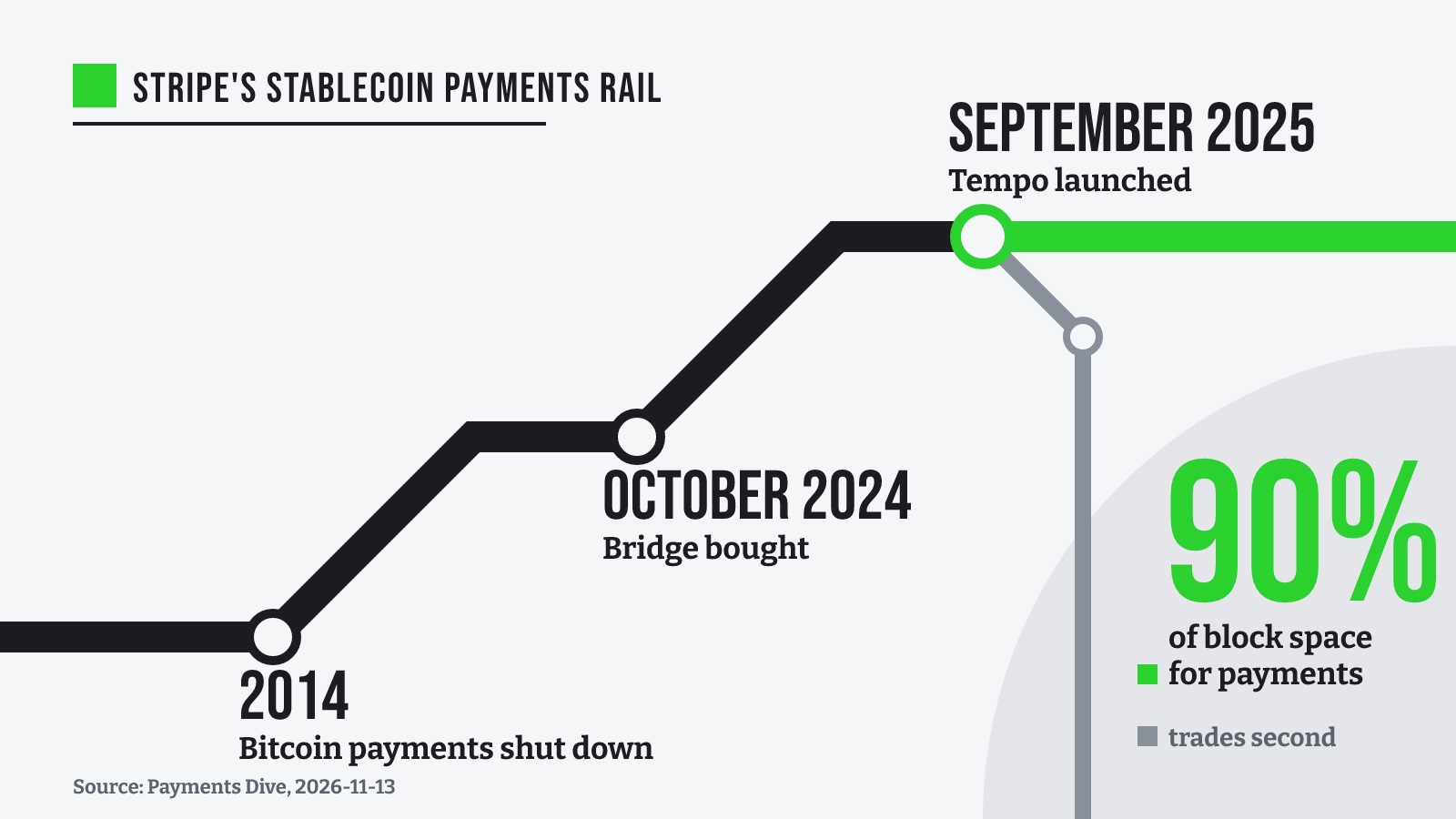
Stripe is betting that payments need a blockchain of their own. In a Nov. 6 interview reported by Payments Dive, Tempo's chief business officer Dan Romero explained why the Stripe-incubated chain reserves most of its capacity for simple transfers rather than trading. This article looks at how money would move on that rail, and where the risk lands once a payout reaches a user's own wallet.
What happened
Tempo is a blockchain built around stablecoins, the digital tokens designed to hold a steady value against a currency such as the dollar. Stripe incubated it and developed it further with the venture firm Paradigm, and it launched in September 2025. Anthropic, DoorDash and the card network Visa were named as launch partners.
According to Payments Dive, Romero, a former Coinbase executive, said companies now use Tempo for cross-border payouts, remittances and agentic commerce, meaning purchases made by software agents on a person's behalf. The chain sits on top of earlier Stripe moves: it bought stablecoin firm Bridge in October 2024 and later acquired wallet provider Privy.
What are stablecoin payments, and why a separate chain?
Stablecoin payments move a dollar-linked token from one wallet to another on a blockchain, instead of moving a bank balance through card or bank networks. Romero said stablecoins first served mostly as a trading pair against other crypto assets, but real-world cross-border flows have grown over the last couple of years.
The problem, in his telling, is that payments and trading compete for the same space on a shared chain. Traders will pay more per transaction, while payments are low margin, so busy chains push payments to the back of the line. He likened it to running Visa and the New York Stock Exchange on a single database, where a payment might wait six hours.
Tempo's answer is a fixed priority. It gives 90% of its block space to plain A-to-B payments and puts trades second. Romero said that choice earns Tempo less per transaction. His summary of the trade-off: "If you're in the business of doing both trading and payments, you are actually in the business of trading."
How the money moves on a stablecoin payout
Romero's clearest example was a delivery marketplace such as DoorDash paying its drivers. Here is the flow, step by step. The first step is our own simplification; the rest follows his sketch.
- The marketplace needs stablecoins to pay from. The interview did not cover how it sources them.
- After a delivery, it sends the driver's earnings as a stablecoin transfer on Tempo. Because blockchains do not close, this can happen 24/7, including weekends.
- The coins land in an embedded wallet inside the marketplace's app rather than in a bank account.
- A virtual debit card linked to that wallet can sit in Apple Pay, so the driver can spend at once. Card spending then rides the usual card networks back to merchants and their banks.
The speed gain is real on the payout leg. A bank transfer usually waits for business days and batch cycles. The stablecoin leg settles on the chain directly. But the money still has to cross back into the card and bank world when the driver spends it or cashes out, and those steps keep their own timing and fees.
Rules and risks: who carries the loss
This is the part only the fine print answers. Romero said payouts to an embedded wallet are self-custodial, meaning the user is fully in control of the wallet holding the coins. Control and responsibility travel together. In a bank account, the bank holds the money and answers for errors, and deposit insurance stands behind it up to its limits. In a self-custodial wallet, no bank holds the balance for the user, so a lost device or a mistaken transfer is mainly the user's problem. A worker can lose money this way.
Romero described the setup as modular infrastructure that is now regulated after the Genius Act, which he called good for enterprises. Regulation of the stablecoin issuer is not the same as protection for the wallet holder, though. The issuer's reserves back the token's value. The wallet's safety depends on the app, the keys and the user. The card provider sits in between, with its own rules on disputes.
For the marketplace, the risk shifts too. It no longer waits on bank payout windows, but it must manage stablecoin balances, pick an issuer it trusts, and handle customer support for a wallet it built into its app.
What to watch
Agent payments are the next test. Romero said they were nearly absent three months ago but have changed in the last two months, and he expects more within six to 12 months. Today most agent transactions run over cards, many through Stripe Link, and he said some big banks are wary of letting agents touch accounts at all.
History is a useful check. Stripe tried bitcoin payments around 2014 and shut them down; Romero said bitcoin proved too volatile, slow and confusing for consumers. Stablecoins aim to remove the price swings, though they bring their own issuer and reserve risk. Whether workers accept holding their pay outside a bank, and who refunds them when something goes wrong, will decide whether Tempo's payout model sticks.
Sources
- Payments Dive, 13 Nov 2026
Written by AI from the sources above and published automatically: before release, a script confirms every figure against the sources and checks for copied text. No editor reviews it. Treat it as background reading, not financial advice.