News analysis ·
M&T's Richer Card Rewards: Who Pays for the Perks
M&T raised grocery and gas rewards on a no-fee card. We trace where reward money comes from and who carries the credit risk on the bank's books.
M&T, a $218.9 billion-asset regional bank based in Buffalo, New York, has raised rewards for grocery and gas spending on one of its credit cards, Banking Dive reported. Payments Dive said the lender is steering its card perks toward simpler rewards tied to routine spending, citing recent customer feedback. This article looks past the perk itself: where the money for a reward comes from, and who is left holding the risk when a cardholder borrows.
What M&T changed, and why
Earlier in November, M&T reworked the rewards structure on one card so that everyday purchases at the grocery store and the pump earn more. The cards still carry no annual fee and keep flexible redemption choices, according to Banking Dive.
The bank frames the move as part of a wider goal. Chris Nichols, M&T's head of retail banking, told Banking Dive that the aim is to be the main banking relationship for its customers, and that this requires a competitive card. M&T offers four credit cards and markets them only to people who already bank with it, not to newcomers. The new features are being promoted on its website, at its ATMs and in branches.
Competition is the backdrop. Nichols pointed to fintechs and nonbanks that build embedded credit programs for brands and retailers. "We know our customers have a lot of options."
How the money moves when a reward card is swiped
A reward is not free money. It is paid out of the economics of each card payment. When a cardholder buys groceries, the merchant's bank, called the acquirer, sends the transaction over a card network to the bank that issued the card. The issuer pays the merchant side, and the merchant receives slightly less than the sticker price.
Most of that gap is interchange: a fee set by the network that flows from the merchant's bank to the card issuer. Interchange is the issuer's main income from purchases on a card with no annual fee. A slice of it is recycled to the cardholder as points or cash back. When M&T raises rewards in a category such as gas, it is choosing to hand back more of that slice on those purchases.
Issuers have two other income sources on a card. One is interest when a cardholder carries a balance from month to month. The other is fees, which this card largely avoids by charging none annually. If a customer pays in full every month and uses the card mostly for high-reward categories, the bank may earn little from that account. The bet is that the customer brings more of the relationship along.
Rules and risks: who carries the credit
Because M&T took its card program in-house in 2010 after earlier relying on a partner, the loans sit with the bank itself. That matters for risk. In a partner model, an outside firm may share in the program's economics and losses. In-house, the issuing bank funds the balances and absorbs the charge-offs when cardholders cannot repay.
M&T has roughly $6.8 billion in card commitments, Banking Dive reported. A commitment is a credit line the bank has promised, whether or not the customer has used it. Unused lines can be drawn quickly, which is why regulators make banks hold capital against them. A bank spokesperson said M&T does not disclose outstanding balances or account counts, so outsiders cannot see how much of that promised credit is actually borrowed.
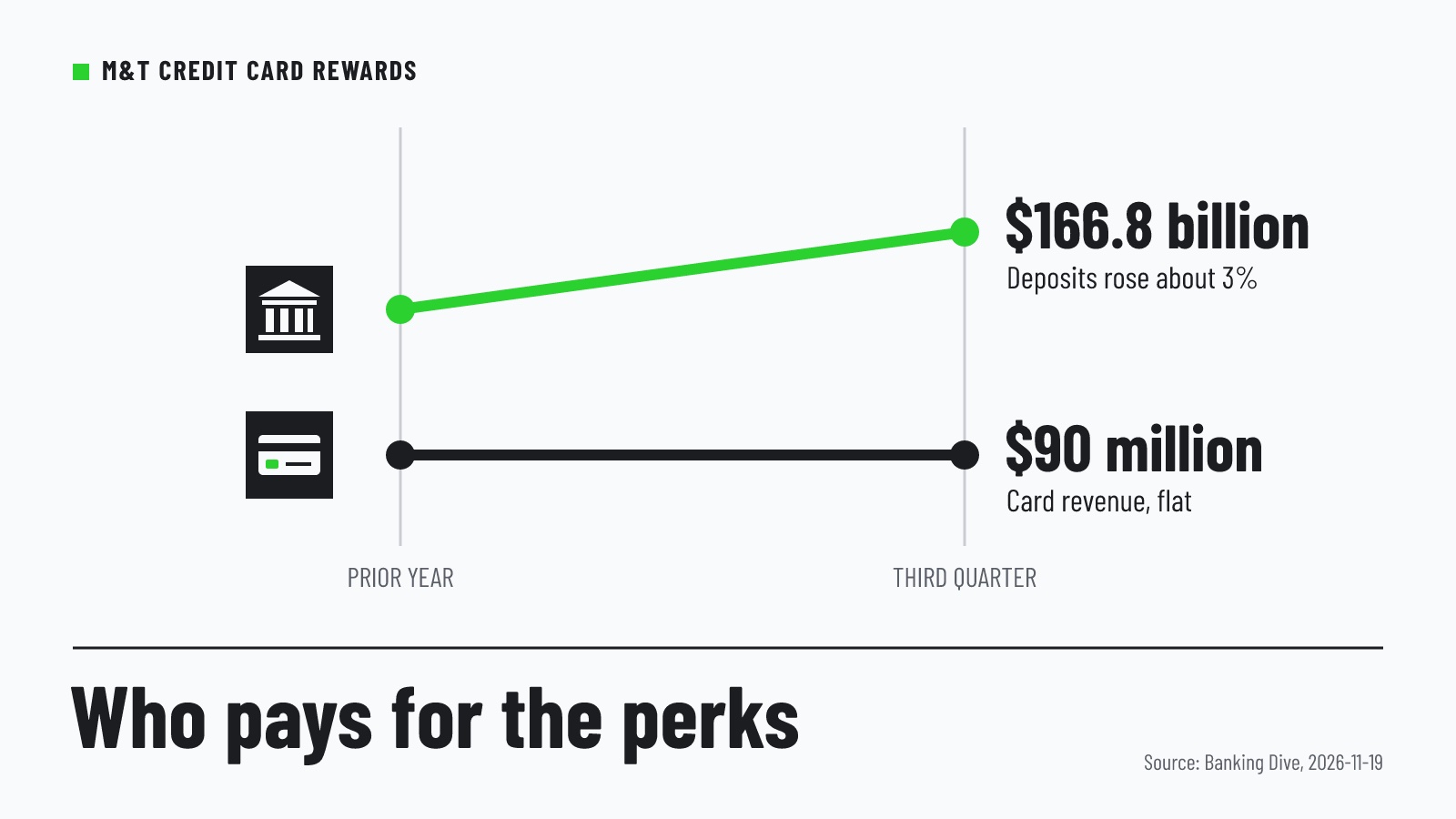
Banks generally fund card balances with customer deposits. At M&T, deposits rose about 3% year over year in the third quarter to $166.8 billion. That link is the point of the strategy. A card that keeps a customer's paycheck at M&T supports the cheap deposit base that pays for lending across the bank.
- Merchants fund most of a reward through interchange, and often pass that cost into prices for all shoppers.
- The issuing bank carries credit losses on balances that are not repaid.
- Cardholders who carry a balance pay interest that can outweigh any reward they earn, so borrowing on a card can leave them out of pocket.
What to watch
Card revenue was $90 million in the third quarter, flat versus the prior year, according to Banking Dive. M&T would not share a growth target for cards or say how much the upgrades cost, calling them only strategic investments. That leaves readers without a way to judge payback yet.
The useful signals will be whether card revenue moves off that flat line, whether deposits keep growing, and whether the bank ever discloses balances. Nichols said M&T will keep adjusting its products and wants to win more customers inside its footprint. For people in the industry, the case shows a common trade: a bank giving back part of its interchange income to hold on to the relationship that funds everything else.
Sources
- Banking Dive, 19 Nov 2026
- Payments Dive, 19 Nov 2026
Written by AI from the sources above and published automatically: before release, a script confirms every figure against the sources and checks for copied text. No editor reviews it. Treat it as background reading, not financial advice.