News analysis ·
FDIC's Hill on AI agents moving deposits: who is liable
FDIC Chair Travis Hill says AI agents moving deposits is a top concern. We trace how that money would move and who carries the risk if it goes wrong.
The head of the Federal Deposit Insurance Corp. says AI agents that move deposits for customers are the big question on his desk. Banking Dive reported that FDIC Chair Travis Hill raised the issue in Las Vegas, at an Axios event on the agentic economy and earlier at Money20/20. This article looks at how an agent would actually move a deposit, who carries the loss when it goes wrong, and where supervision has gaps.
What Hill said
Hill told the audience that agents shifting deposits on behalf of customers is the main issue his agency is weighing, and that many banks are weighing it too. He expects some depositors to hand that authority over. The open point, as he framed it, is how many will do so and how much it changes the market.
"There's just a big question of, to what extent are depositors going to delegate that type of decision-making authority to these types of agents?" Hill said, according to Banking Dive.
The topic came back after Meta launched its Muse assistant and Stripe added its Link wallet so Muse can buy things for consumers. Big banks have already reacted. Citi and Bank of America have followed JPMorgan Chase in blocking outside AI agents from customer bank accounts, citing safety and soundness worries.
How the money moves when an agent is in charge
An AI agent is software that acts for a person, not just answers questions. To move a deposit, it needs a way into the account. That usually means one of two routes: the customer shares login details so the agent can act inside online banking, or the bank grants access through an API, a controlled data and payment connection.
Once inside, the agent sends a transfer order. The money leaves the customer's account at Bank A, travels over a payment rail such as ACH or an instant payment system, and lands at Bank B. For the banks involved, nothing about the transfer looks unusual. What changes is who made the decision. A person did not choose the timing or the destination; software did, under a broad instruction such as find me a better rate.
- The customer owns the money and gave the instruction, but may not see each move.
- The agent provider wrote the logic that picked the destination and timing.
- The sending bank executes an order that arrives with valid credentials.
- The receiving bank takes in a deposit that may leave again just as fast.
This helps explain the bank blocks. The banks cite safety and soundness worries. One plain reason is that when credentials are shared with a third party, a bank cannot easily tell an authorised agent from a criminal using the same login.
Who carries the loss
JPMorgan chief Jamie Dimon has warned that using an agent shifts liability, so consumers should know what they are signing up for. In plain terms: if an agent sends money to the wrong place, the customer may struggle to argue the payment was unauthorised, because the customer let the agent act. PNC CEO Bill Demchak and Fifth Third CFO Bryan Preston have both said accountability needs to be settled before agents transact for customers.
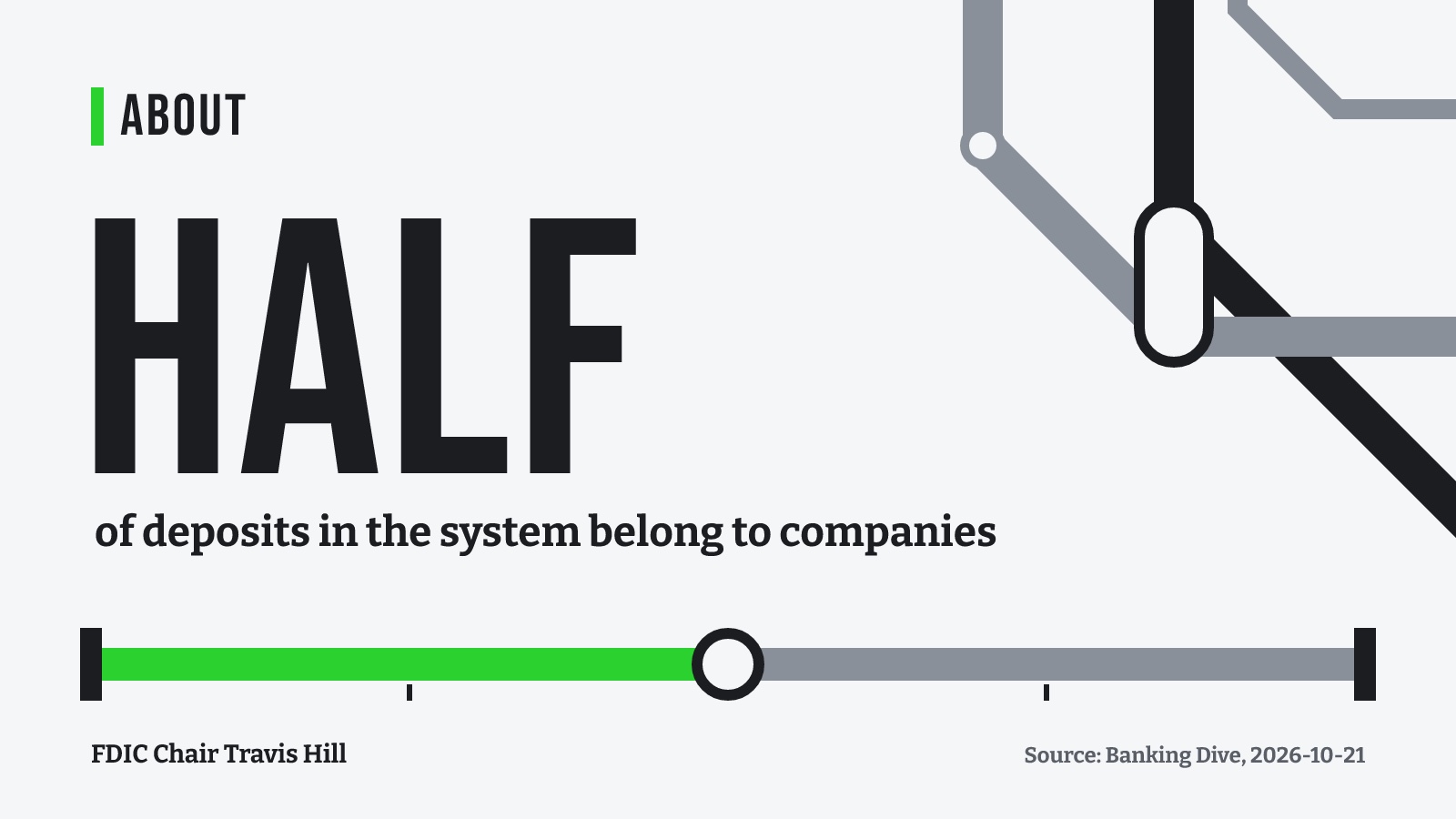
There is a second risk that sits with the banks themselves. Deposits are the cheapest funding a bank has. Hill noted that many customers earn close to zero on deposits because they value other services, and that about half of the deposits in the system belong to companies. In his telling, those customers stay for other bank services, not for rate. If agents make rate shopping automatic for households, the stickiness of that money could weaken. A bank that funds loans with deposits would then need to pay more or hold more cash in reserve.
Deposit insurance is a separate question. The Banking Dive report does not say how it would apply to a loss caused by an agent's error, so treat that as open.
The supervision gap
Banks manage software risk under model risk management guidance, the rules on how to test and control the models that drive decisions. The FDIC, the OCC and the Federal Reserve revised that guidance earlier this year, but it does not cover generative or agentic AI, and Hill said it fits those tools poorly. He said the FDIC is thinking about future guidance and may ask the public how to supervise agentic AI.
The agency is also using AI on its own work. Hill said the FDIC runs a couple of AI tools and he wants it to move faster, calling government less nimble than firms. He sees uses in loan reviews and safety and soundness exams. When a bank fails, AI could help the FDIC make timely deposit insurance determinations, the step that decides which depositors are covered, and review trust documents.
What to watch
Hill plans to meet West Coast companies in the coming days to learn about agent capabilities, adoption, costs and how the industry is reacting. Watch for whether the FDIC formally asks the public for input on agentic AI supervision, and whether more banks join the block on outside agents or move toward approved API access instead. For now, the access terms each bank sets are where the question of who is liable gets its first practical answer.
Sources
- Banking Dive, 21 Oct 2026
Written by AI from the sources above and published automatically: before release, a script confirms every figure against the sources and checks for copied text. No editor reviews it. Treat it as background reading, not financial advice.