News analysis ·
Custodia Loses Fed Master Account Fight: Who Holds Risk
The Supreme Court will not hear Custodia Bank's Fed master account case. We explain how money moves without direct Fed access and who carries the risk.
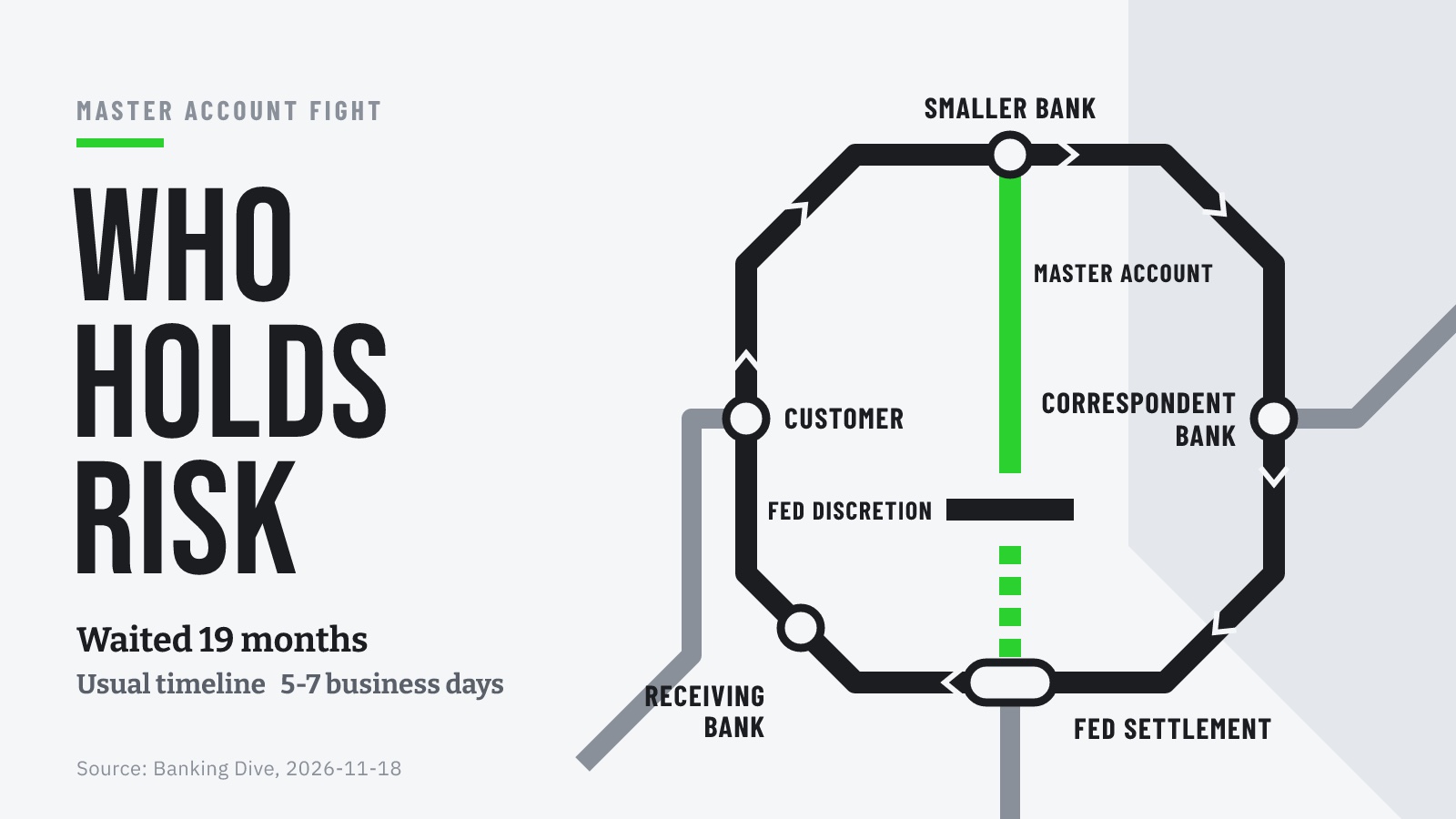
The US Supreme Court has declined to hear Custodia Bank's long fight for a Federal Reserve master account, Banking Dive reported. The refusal leaves the lower court rulings against the Wyoming digital lender in place. This article looks at what a master account actually does, how a bank moves money without one, and who ends up carrying the risk when access is left to the Fed's judgment.
What happened
On Monday the court refused to take up Custodia's petition. That leaves in place a 10th Circuit decision which held that the Fed and its regional Reserve Banks have discretion over who gets a master account. Custodia had asked the justices to review that ruling in July.
The dispute is old. Custodia sued the Fed in June 2022, after its application had waited 19 months, according to Banking Dive, while Fed materials pointed to a usual timeline of 5-7 business days. In January 2023 the Fed and the Kansas City Fed rejected the application. They said the business leaned too heavily on volatile crypto markets, had weak controls against illicit finance, lacked a track record in traditional risk management, and could have systemic effects if a crypto-focused firm got direct access. Custodia also argued that the Fed had moved quickly to let BNY custody client crypto assets, a claim of favoritism the Fed rejected.
How the money moves with and without a master account
A master account is a bank's own account at the central bank. With one, a bank can hold reserves at the Fed, settle payments with other banks in central bank money, and send transfers directly over Fed systems. Settlement here means the final step where money actually changes hands between institutions.
Without one, a bank has to work through an intermediary, usually called a correspondent bank. The flow looks like this. A customer of the smaller bank sends a payment. The smaller bank does not settle it at the Fed itself. Instead it instructs its correspondent, which debits the smaller bank's balance on its own books and then settles with the receiving bank through its own Fed account.
- Customer funds sit at the smaller bank as deposits.
- The smaller bank holds its liquidity as a deposit at the correspondent, not as reserves at the Fed.
- The correspondent sets the cut-off times, fees and limits for outgoing payments.
- If the correspondent ends the relationship, the smaller bank's payments can stop until it finds another partner.
This is the core of the fight. Direct access removes a middleman, and with it a layer of cost and dependency. It also puts the central bank's own balance sheet and payment systems closer to the new entrant's risks. The Fed itself pointed to possible systemic effects of giving a crypto-focused firm direct access.
Rules and risks: who carries what
With a correspondent in the chain, the risk is spread differently. The smaller bank carries counterparty risk on its correspondent, since its working cash is a claim on another private bank. The correspondent carries compliance and operational risk for the payments it pushes through on the smaller bank's behalf, which is why such partners can be cautious about crypto-linked clients. The Fed sits one step removed.
Direct access shifts that picture. The Fed would deal with the institution itself, so the central bank's judgment about controls, anti-money laundering checks and liquidity becomes the main safeguard. That explains why the Bank Policy Institute welcomed the outcome. As BPI executive vice president Paige Pidano Paridon put it, "Access to a Federal Reserve master account is a privilege, not a right".
Critics see a different risk. Judge Timothy Tymkovich, dissenting from the 10th Circuit ruling in October 2025, argued the Fed was claiming unreviewable discretion over access to the financial system. Julie Hill, law dean at the University of Wyoming, warned that leaving it to the Fed opens the process to political influence and to policy swings between administrations. For a new bank, that means its business model can depend on a decision it cannot challenge in court.
The skinny account middle path
The Fed has since created so-called skinny master accounts, which give tailored features to different tiers of institutions. Kraken received the first one in March. Fed Governor Christopher Waller said at The Clearing House annual conference that these accounts may have undermined Custodia's case, because the Solicitor General pointed to them as evidence that the Fed was open to new entrants.
A narrower account changes the risk split again. A firm may gain some direct functions while the Fed limits what it can do, so part of the dependency on partner banks can remain.
What to watch
Custodia and its CEO Caitlin Long had not commented, according to Banking Dive. The lender could apply for a skinny account, or wait on another challenge. PayServices, based in Idaho, is suing the San Francisco Fed; a district judge sided with the regulator and the case is now on appeal in the 9th Circuit. The court's refusal came even though a sitting senator and a former senator filed a brief in Custodia's support.
Sources
- Banking Dive, 18 Nov 2026
Written by AI from the sources above and published automatically: before release, a script confirms every figure against the sources and checks for copied text. No editor reviews it. Treat it as background reading, not financial advice.