News analysis ·
MAX Credit Union Buys a Bank: Who Carries the Risk
MAX Credit Union plans to buy Alabama's First Financial Bank. We explain how deposits, loans and insurance change hands, and who bears the risk.
MAX Credit Union, based in Montgomery, Alabama, has agreed to buy First Financial Bank, a community bank in Bessemer near Birmingham, Banking Dive reported. The cash price was not disclosed and the deal is expected to close in 2027. This article looks at what actually changes for the bank's customers when a credit union takes over: where their money sits, who insures it, who lends it out, and why community bankers object.
What happened
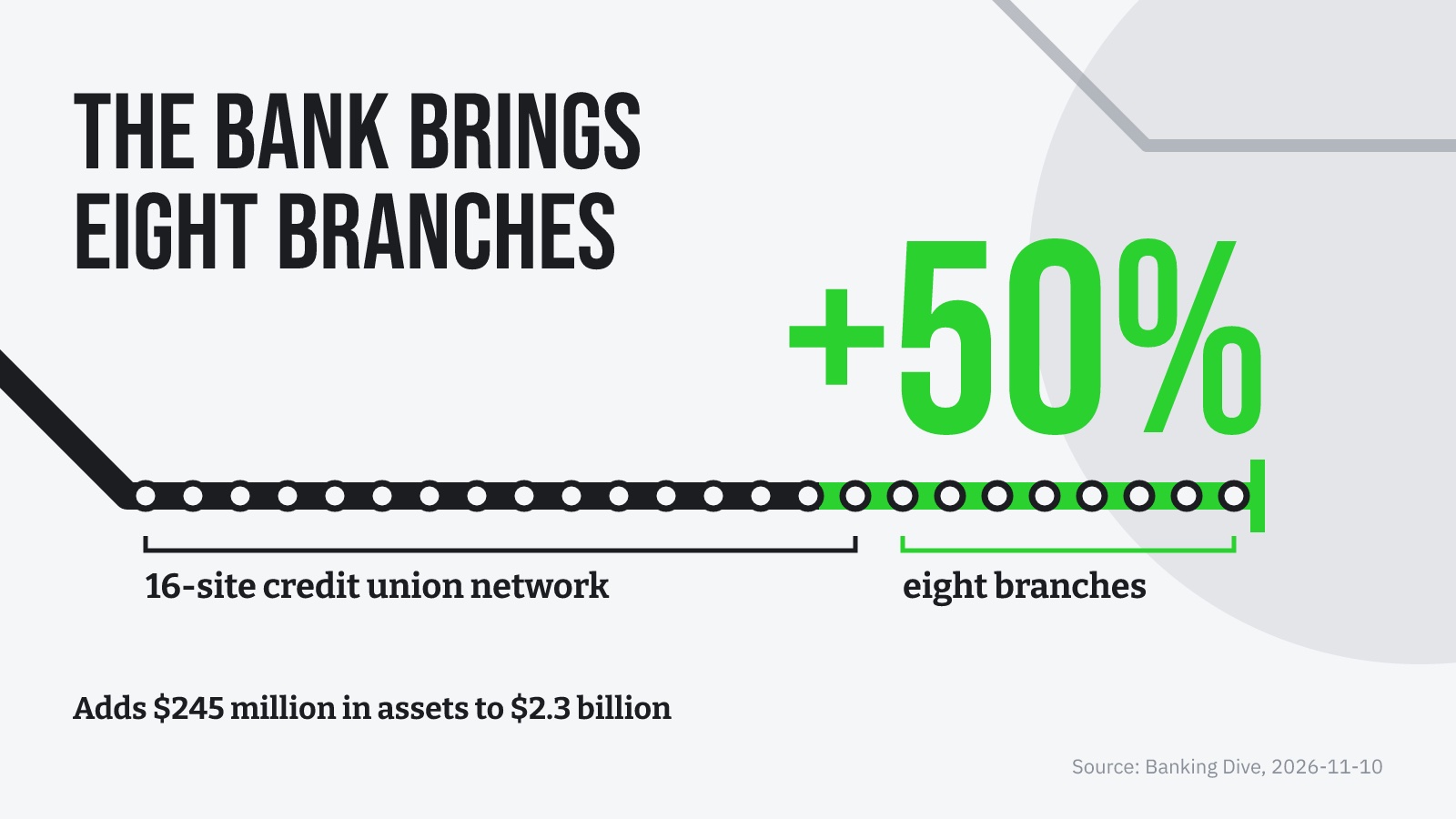
According to Banking Dive, which cited a Tuesday release first reported by CUToday, MAX will pay cash for First Financial, whose parent company is FirstFed Bancorp. It is the first bank MAX has ever bought. The purchase adds $245 million in assets to a credit union that already holds $2.3 billion.
The bank brings eight branches. That lifts MAX's 16-site network by 50%, and MAX said it plans to keep every First Financial location open. The aim is to offer home loans, wealth management, insurance and loans to businesses across the Birmingham metro, the largest in Alabama.
MAX CEO Martin Head said First Financial has served local families and businesses for nearly 90 years. "Our two organizations share a belief that a financial institution should be measured by how well it serves its neighbors," he said. B. Kyle Goodwin IV, CEO of FirstFed Bancorp, called MAX the right partner to continue the bank's service tradition.
How the money moves when a credit union buys a bank
A bank and a credit union both take deposits and make loans, but they are owned differently. A bank is owned by shareholders, and profits flow to them. A credit union is a cooperative owned by its members, and surplus is meant to come back to members through lower loan rates, higher savings rates or fewer fees.
In a deal like this, the money does not flow to the bank's customers. The cash price goes to the seller, here the bank's parent company and, through it, its owners. What the credit union receives is the bank's balance sheet: its loans, which are the assets, and its customer deposits, which are the liabilities it must repay on demand.
For a customer, the practical shift is one of status. A depositor at a bank is a creditor of a company. After a merger of this kind, that customer would normally be invited to become a member of the credit union, and the account would usually be treated as a share in a cooperative. The Banking Dive report does not say how MAX will handle this. The branch on the corner may look the same, but the legal relationship behind the balance changes.
Rules and risks: who is regulated and who bears losses
Deposit insurance is the first thing to check. Bank deposits are insured by the FDIC. Credit union shares are insured by a separate federal fund run by the National Credit Union Administration. Both are backed by the U.S. government, but they are different funds with their own rules, so customers who hold large balances should confirm how their accounts will be covered once the deal closes.
Credit risk also moves. Every loan on First Financial's books becomes MAX's problem. If some of those borrowers fall behind, the losses hit the credit union's capital, which ultimately belongs to its existing members. A first-time acquirer also takes on integration risk: moving accounts onto new systems is where errors and outages tend to appear.
Then there is the policy fight. Credit unions do not pay federal income tax on their earnings. The Independent Community Bankers of America says data show these deals hurt small businesses and shrink local lending capacity. In a statement last month, the ICBA argued community banks outperform credit unions in high-poverty areas that credit unions are subsidized to serve, and urged policymakers to revisit the tax and regulatory exemptions that it says drive these purchases.
Credit unions push back. Scott Simpson, CEO of America's Credit Unions, warned that tax code changes could hurt how credit unions help consumers and communities. He said the tax-exempt status benefits the finances of 146 million U.S. credit union members.
What to watch
The deal is not expected to close until 2027. Banking Dive noted it is the ninth bank purchase by a credit union announced in 2026, down from a record 22 in 2024 and 16 last year. Watch for:
- How MAX explains the switch in deposit insurance to First Financial customers.
- Whether business lending in the Birmingham area grows or shrinks after the merger, the core of the ICBA's complaint.
- Whether lawmakers take up the ICBA's call to revisit credit union tax and regulatory exemptions.
The answer to who carries the risk is split. The seller takes cash and walks away. The credit union's members take on the bank's loans. And the ICBA argues that the tax and regulatory exemptions credit unions enjoy are what drive such purchases, a point credit unions dispute.
Sources
- Banking Dive, 10 Nov 2026
Written by AI from the sources above and published automatically: before release, a script confirms every figure against the sources and checks for copied text. No editor reviews it. Treat it as background reading, not financial advice.